county list


|
Turn smartphone to horizontal
view. SELECTED SITES IN COUNTY ARMAGH Place-names in italics refer to listed entries. Convert Irish Grid references to Latitude/Longitude |
|
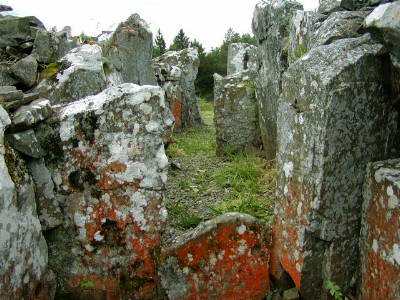
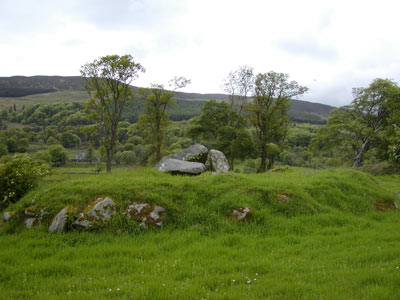
The most westerly of a group of monuments around the sacred mountain of Slieve Gullion, this (The Black Castle) is a very fine, excavated example of a single-court tomb, whose out-of-line, south-facing, horseshoe-shaped court is very well preserved. It is over 8 metres in diameter, with walls of large orthostats alternating with sections of good dry-walling: a typical "post-and-panel" construction. Such a forecourt might well have had special acoustical properties important in ritual. The gallery is 7 metres long, segmented by jambs (one of which has an uncompleted cup-mark) into 3 chambers. Much of the cairn (which is nearly 20 metres long) survives to a height of 1.8 metres. Two lateral chambers at the N end of the cairn were built a little later than the rest of the tomb, and have independent entrances. The siting of the tomb on a rock outcrop is unusual. The site itself has been unusually well and sensitively landscaped, with an unintrusive fence and a pleasant woodland approach. Aughnagurgan:
Portal-tomb and passage-tomb The wrecked passage-tomb is right beside the road towards which the ruined passage leads. In the middle of the field is the collapsed portal-tomb whose handsome fiddle-shaped capstone of fine-grained granite has fallen back with the portal-stones. This would have been an impressive dolmen when it was standing. ~ 7.5 km WNW in Mullyard (H 798 312) is a fine standing-stone about 2 metres high on top of a hillock - which seems to be the only survivor of an alignment. ~ 3.2 km due S, in County Monaghan, is Mullyash passage-tomb. Ballykeel:
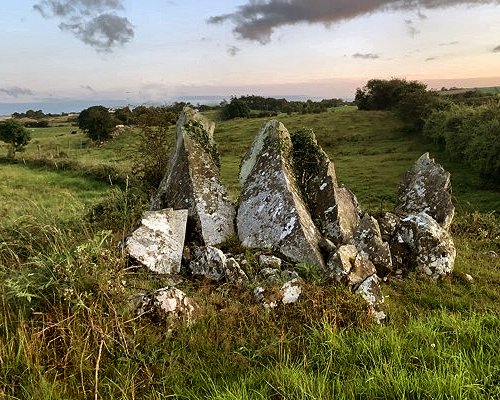
Portal-tomb A fine "tripod-dolmen" stands at one end of the remnants of a long cairn in Mullaghbawn townland, 7.2 km SW of Camlough, with a ¾ door-slab between the portal stones, which are about 2 metres high. The slab-capstone (the only one actually to have been replaced on a portal-tomb) is nearly 3 metres long, and is noticeably notched. At the other end of the cairn was a box-like kist-tomb. Parallel with the stone-kerbed long sides of the cairn are 2 straight lines of stones, set in the cairn. The once-pleasant site is now hemmed in (like many in Ireland) by grotesque and ostentatious modern dwellings (which is how the indefensible Iron Age cashels must have seemed when they were built). ~ About 800 metres NW (H 001 209) in Aughadanove is a long mound which looks very much as if it might contain a megalithic tomb, though it is not mentioned in the archæological literature. What is mentioned, though, is a round mound at H 983 208 in Tullymacreave which may contain a small passage-tomb. ~ 2.8 km NE (on Sheet 29) just visible from the narrow road in the middle of a rocky outcrop in a non-bungaloid pocket of beautiful wild landscape (J 016 234) is Ballard "Long Stone", an elegantly-pointed, very huggable, small standing-stone, some 1.5 metres high, leaning at an angle towards the S. ~ Several km SW of Ballykeel, immediately to the S side of Larkins Road, SE of Crossmaglen and about 12 fields from the border with county Louth (54°03'57" N ; 6°33'48" W according to Google) are the still-impressive remains of what looks like Ballykeel Dolmen's little brother - minus a capstone, but with two very well-matched portal stones and a long cairn.
~ Just over 4.8 km
E by S is Clonlum round cairn (see below). Ballymacdermot:
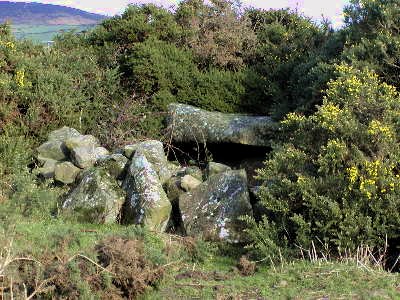
Court-tomb click
on the thumbnail for a larger picture 3.2 km SW of Newry, and commanding fine views to the E this small, three-chambered tomb (built around the middle of the fourth millennium BCE) is entered from a shallow, asymmetrical forecourt of small and medium-sized stones. A few of the corbel-stones supporting the now-vanished roof survive. ~ 3.4 km SW (via the 10th century Killevy Church with its cyclopean W doorway) in Clonlum (J 045 214 and marked Chambered Grave on sheet 29) are the sad and overgrown remains of a court-tomb, whose gallery is nearly 9 metres long, with a shifted roofstone at the N end, beyond which 5 court stones survive. A small rectangular chamber is set within this court.
About 600 metres SSW of this, in the same townland, (J 046 206, marked Cairn on Sheet 29) is a small round cairn, containing a tomb morphologically intermediate between a portal-tomb and a megalithic kist. A massive (now broken) capstone was originally 2.7 metres long. A door-slab was placed, not between the portal-stones (which are over 2 metres high) but between the side-slabs of the chamber.
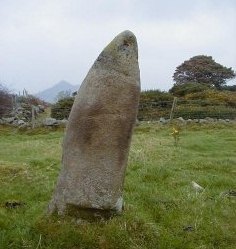
~ 4.7 km WNW in Aghmakane
(J 020 253, marked Standing Stones and Cashel on sheet
29) in a field behind a house to the SE of the B.30 road are
more "Long Stones": the impressive remains of a tomb,
comprising a blade-shaped portal-stone 3 metres high, with an
impressive door-stone about 2.4 metres high, and the stump of
the other portal-stone adjoining the overgrown remains of a
cashel (from Latin castellum) or circular stone
fort which was very likely built after the ruination of perhaps
the highest dolmen in Ireland. Another of its fine stones is
incorporated in the cashel wall nearby.
click
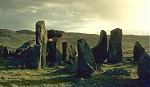
on the thumbnail for more Although somewhat mutilated, this tomb, known as The King's Ring (close to the Border with county Louth) is still very impressive, with most of the forecourt's massive orthostats surviving. Similarly large sidestones delineate what is left of the gallery which has 3 chambers, the first of which has a slipped lintel and a large capstone over 3 metres long partly-supported by corbel-stones. It is unfortunate that a typically charmless bungalow has been built close by, but environmental planning in Ireland is notable for its absence. Scant remains of another court-tomb, marked by a clump of "fairy thorn" are some 200 metres to the S. These monuments and others were pillaged to build the Newry Canal in the 18th century. The townland name is pronounced "Clinchycora". ~ 5.6 km NNW is another court-tomb at Ballymacdermot (see above). ~ Just under 6 km SW is the fine Christianised standing-stone (2.1 metres high) at Kilnasaggart. Navan
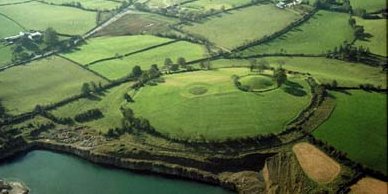
'Fort' Two kilometres W of Armagh City, this complex and intriguing monument of enclosures, mounds, ditches, the only prehistoric artificial lake in the British Isles, and buried sacred objects - also known as Emhain Macha, and historically the scene of an important annual festival known as Eonach - was excavated over many years, and the results are displayed in a Visitors' Centre which is open seven days a week.
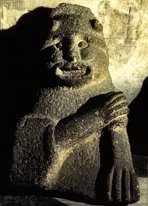
~ The figure which is the logo of this website (in the left-hand column) - a statue of the Horned-Helmeted god Nuadú of the Silver [artificial] Arm, was - at least until recently - kept with a miscellany of other figures in the vestry of Armagh (Anglican) Cathedral, where I photographed it. ~ 1 km ESE are The King's Stables, a beautiful, overgrown water-ritual site, well described and illustrated on the Voices of the Dawn website. Slieve
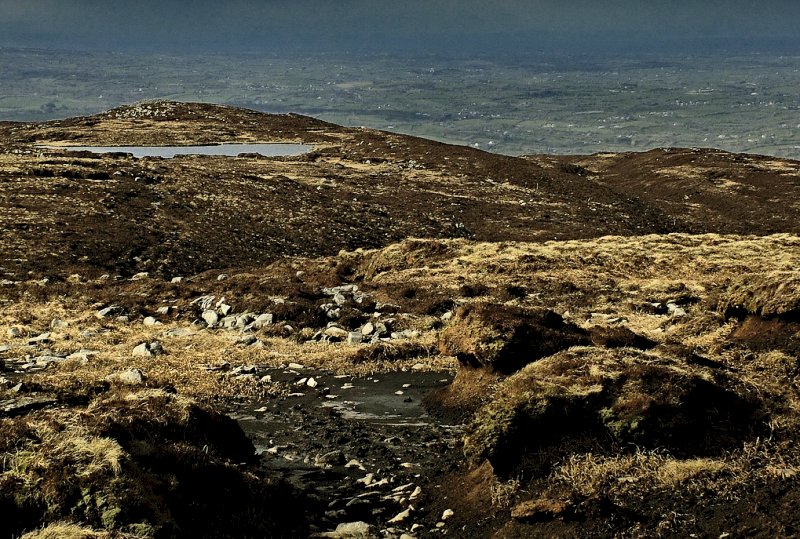
Gullion: Passage-tomb The
easiest way to visit this tomb is by the spectacular drive through
Slieve Gullion Forest Park (open officially in summer only!)
to the highest point, from where a signposted track leads up
the rest of the legend-rich mountain to the S of the summit
ridge. Slieve Gullion is associated with the legendary Ulster
hero Cú Chulainn ('Hound of Ulster'), and with that avatar of
the Celtic hag-goddess known in Ireland as the Cailleach
Bhéarra. The passage-tomb is known as
"Caillech Birra's House", the nearby dark lake as
"Caillech Birra's
Lough" - and the Loughcrew passage-tomb complex, to
which the passage of this tomb points, is on the Slieve na Calliagh
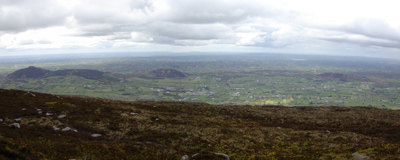
hills, some 60 km away. In good weather, a splendid view over almost half of Ireland rewards the visitor far more than the tomb, which, like that at Knockmany in Tyrone, is now enclosed in a concrete shelter - due to vandalism in the mid-twentieth century.
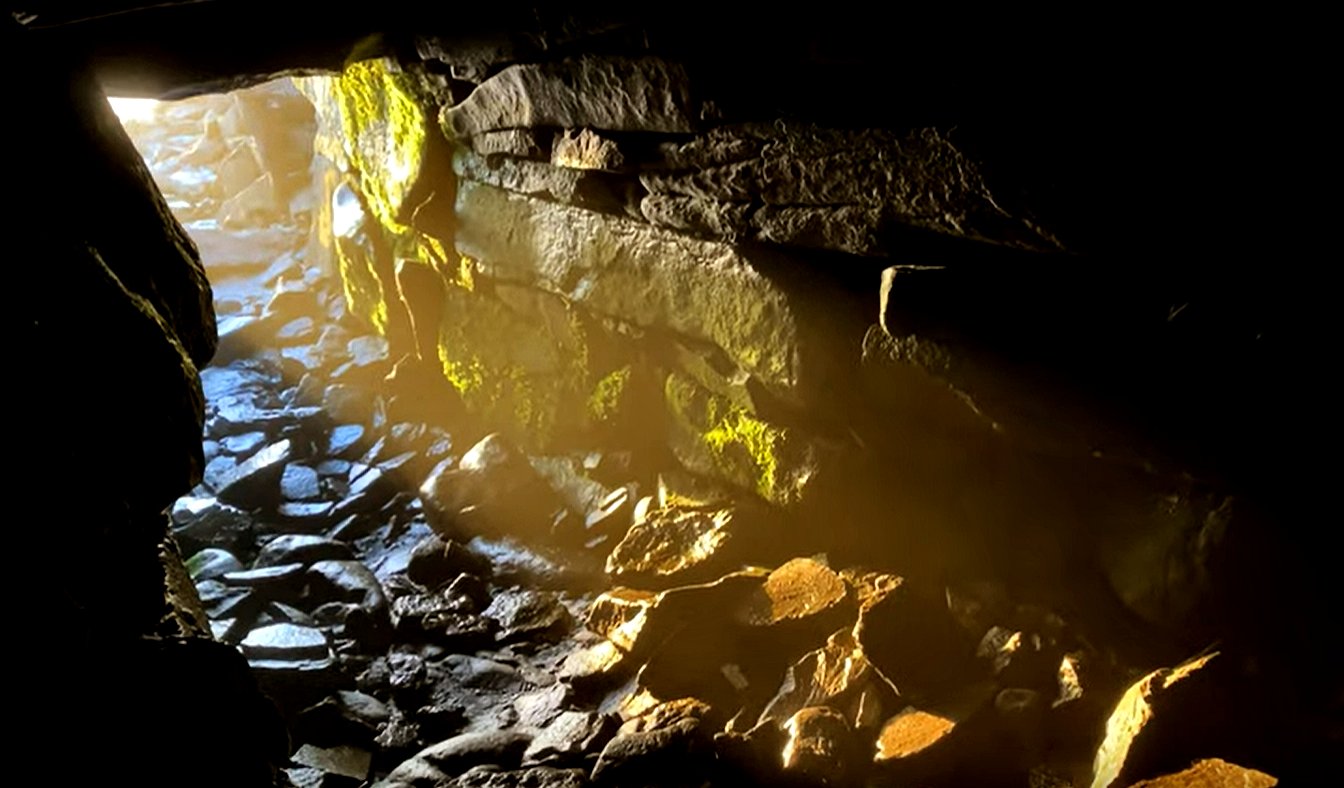
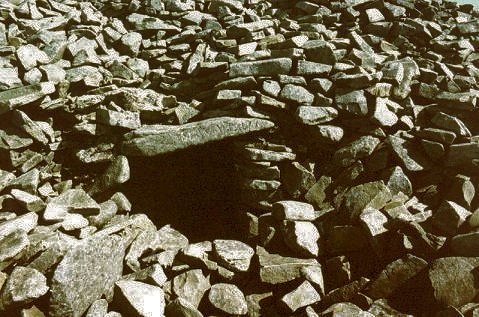
It has more in common with Continental tombs than the nearby Irish examples. The cairn is 30 metres in diameter contained by massive kerbstones which are - unusually for Ireland - laid flat. The lintelled passage of the almost cruciform tomb is more than a metre high and wide, and 4.5 metres long. It leads to a chamber about 3 metres in diameter whose corbelled roof has been partly reconstructed using concrete beams. It contains a basin-stone, which is illuminated by the rays of the setting sun at the period of the winter solstice.
The octagonal
chamber and the passage have dry-stone walling (reminiscent
of some court-tombs as well as Breton passage-tombs): the only
orthostats frame a recess in the chamber opposite the passage.
For further, detailed information and a "seven-node VR environment" see the Voices from the Dawn website. ~ 2 km E by N is one of the tombs at Clonlum (see under Ballymacdermot, above). |