|
the
earth-mother's
HOW TO IDENTIFY COURT-TOMBS
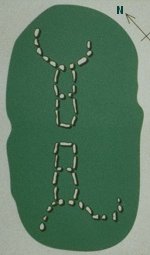
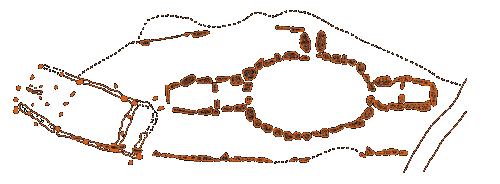
Court tombs have several distinctive characteristics that allow easy identification when in fair condition. One key feature that is a great help, no matter what the condition, is that court tombs are nearly always aligned north to south. The easiest feature to identify is the court, behind which extends a long, usually divided, passage-like gallery. The galleries of these tombs were covered with cairns, mostly now absent or reduced - but not the courts. Galleries may be segmented into up to five chambers by stone jambs. The walls are normally made of large slabs set side by side. The rooves were created by laying large slabs across the gallery, either directly on to the tops of the side-stones or (more often) resting on corbel stones. Two large stones, with smooth forward-facing faces, usually form the entrance or doorway, and it is possible to identify a court tomb when only these stones remain. Single-court tombs usually have a half-court: a horseshoe of stones (usually on the same axis) funnelling into the gallery. Full-court tombs have a court which is a near-full or penannular circle of stones, with a narrow entrance to the court facing the entrance to the gallery. Double-court
tombs are really two single-court tombs back to back, sometimes
sharing a back-stone, sometimes with a distance between their back-stones. Plan of the double-court tomb
at Ballywholan, county Tyrone.
Centre-court tombs are two single-court tombs placed front to front (court to court), to which access is gained through entrances placed (usually) in the east and west sides of the court. Subsidiary
Chambers: Anthony
Weir _______
|


|
IRISH PREHISTORIC ARCHITECTURE  for the ashes of the dead, for the stomachs of the living.
|
|
PREAMBLE Humans were nearly wiped out 70,000 years ago (from CNN online) WASHINGTON
(AP) Human beings may have had a brush with extinction 70,000
years ago, an extensive genetic study suggests. Geneticist Spencer Wells declares that the study tells "truly an epic drama." The human population at that time was reduced to small isolated groups in Africa, apparently because of drought, according to an analysis released on Thursday. The report notes that a separate study by researchers at Stanford University estimated that the number of early humans may have shrunk as low as 2,000 before numbers began to expand again in the early Stone Age. "This study illustrates the extraordinary power of genetics to reveal insights into some of the key events in our species' history," said Spencer Wells, National Geographic Society explorer in residence. "Tiny bands of early humans, forced apart by harsh environmental conditions, coming back from the brink to reunite and populate the world. Truly an epic drama, written in our DNA." Wells is director of the Genographic Project, launched in 2005 to study anthropology using genetics. The report was published in The American Journal of Human Genetics. Studies using mitochondrial
DNA, which is passed down through mothers, have traced modern humans
to a single "mitochondrial Eve," who lived in Africa about
200,000 years ago. The migrations of humans out of Africa to populate the rest of the world appear to have begun about 60,000 years ago, but little has been known about humans between Eve and that dispersal. The new study looks at the mitochondrial DNA of the Khoi and San people in South Africa, who appear to have diverged from other people between 90,000 and 150,000 years ago. The researchers (led by Doron Behar of Rambam Medical Center in Haifa, Israel, and Saharon Rosset of IBM T.J. Watson Research Center in Yorktown Heights, New York, and Tel Aviv University) concluded that humans separated into small populations before the Stone Age, when they came back together and began to increase in numbers and spread to other areas. Eastern Africa experienced a series of severe droughts between 135,000 and 90,000 years ago, and researchers said this climatological shift may have contributed to the population changes, dividing into small, isolated groups that developed independently. Paleontologist Maeve Leakey, a Genographic adviser, asked, "Who would have thought that as recently as 70,000 years ago, extremes of climate had reduced our population to such small numbers that we were on the very edge of extinction?" Today, more than 6.6 billion people inhabit the globe, according to the U.S. Census Bureau. The research was funded by the National Geographic Society, IBM, the Waitt Family Foundation, the Seaver Family Foundation, Family Tree DNA and Arizona Research Labs.
The
oldest known temple complex in the world
IRELAND IN THE 'STONE AGES'
As for what they looked like when they were built in fertile upland clearings of the vast forest that covered most of Ireland and Scotland (except for the windswept coasts and highest mountains), anyone can easily imagine. In those times there was a wealth of animal and plant-life inconceivable today. The builders of those tombs, the erectors of those standing-stones, began the now-inexorable process of man's favourite activity: destruction in the name of construction. History is the account of our fascination by power, its acquisition and exercise. Megaliths may have been a response too social and demographic stress due to agricultural settlement. They are particularly dense on islands, especially in the Mediterranean. They covered Ireland rather as Romanesque churches cover Western Aquitaine - or as cell-phone masts and electricity pylons cover Europe today. Indeed, more so, because large concentrations all over the island (especially south Dublin, north Clare and several areas of Tyrone and Cork) formed 'megalithic landscapes' or vast sets for amazing prehistoric theatre and son-et-lumière spectacles. The big difference between the kinds of power-erections lies not so much in the now-charming individuality and æsthetic quality of Irish megaliths as in the mystery and ceremony which surrounded them - for we live now in an unprecedentedly and cripplingly anti-mysterious and anti-ceremonial culture. At some places. at some times, the people or bodies placed or walled up in megalithic tombs might have been deemed magical or accursèd – epileptic, spastic or suffering from cerebral palsy. Just as a great many folk-tales involve local landscapes and topographical features such as hills and cliffs, lakes and forests (important to people not moving about in the bubbles of their cars), so it is reasonable to suppose that many megalithic tombs were deliberately sited in relation to the landscapes of the time, especially dominant hills, horizons, streams and forests. Lines of sight must at least occasionally have been cleared s through the woodlands and forest - and some of them would have become tracks. Though the forests have gone, sufficient numbers of tombs offer views of significant or significantly-shaped hills, often with panoramas, for us to assume a powerful connection between the temple-tombs and the landscape. But the raisers of those stones, the builders of those mortuary-houses or tomb-temples to ancestor-worship, we the untameable adapters and tamers of landscape, did not wipe out the well-adapted Mesolithic hunter-gatherers who lived rather well along the rivers and more favourable estuaries on a rich diet of fish, crustacea, shellfish, nuts, berries and occasional game. We are the same people - and the Neolithic revolution was cultural and technological rather than slaughteringly-imperial in the manner of the unprecedented European holocausts of North and South America. But it has emerged that in the thousands of years between the demise of the Mesolithic people and the arrival of the Romans in Britain, fish and shellfish were hardly consumed at all: presumably they were considered to be food for sub-humans only. How can we imagine the mind-set of megalith-builders when modern 'Caucasians' cannot understand the mind-sets of contemporary Muslims, Hindus or 'Animists' ? It has been established by analysis of mitochondrial DNA that the entire modern European (and from-Europe) population are partly descended from just seven women who lived at different times from 45,000 to 10,000 years ago. These women were themselves (at least) partial descendants of just one woman who left Africa (or whose daughters left Africa) much earlier still. Similarly, through analysis of DNA in the Y-chromosomes peculiar to men, modern European peoples can trace their origins back to ten Stone Age men. These 'Ur-parents' were not Neolithic farmers but Palæolithic and Mesolithic gatherers and hunters. Thus the Neolithic cultural revolution occurred by imitative adoption of crop- and animal-raising at different times in different places. The climate in Ireland in Neolithic times was like that of Western Portugal or Oregon today, which is one reason why people favoured and hence cleared the uplands and low hills which are so plentiful in Ireland. At that time the lower land was dense forest full of wild pig, various kinds of deer, bears and wolves. Farm-based people are at great pains to say that hunter-gatherers have poor diets - because the opposite is true. Purely farm-based diets tend to produce a restricted range of foods (with accompanying vitamin-deficiency) in very poor return for huge effort and totalitarian restriction of freedom. There is an inevitable reduction of biodiversity to the present pitiable levels - but no reduction of the diversity of human disease and desire. Because technology - however poor at giving us the food we are actually designed to eat, as we are now beginning to realise - always produces weapons for the arthritic, rickety and cancerous, those sick and ever-sicker, ever-more-technological societies take over the healthy in body (and especially in mind) in a process of survival of the least fit. And of course invent religion to deny what reason would otherwise show them. Before the megalithic tombs (or mortuary-houses) were constructed, the burial places of the Mesolithic people might be described as places of return to the earth. Megaliths, however, are rather more arrogant and rather more complex. The dead who were deposited in them were, in a sense, not allowed to die, but were used as servants or instruments of the kind of earth-conquering cults (such as Capitalism and Islam and Christianity) that we have today. They
were the ancestors, effectively trapped in stone houses, while the
living, who inhabited wooden dwellings, organised cults around them.
Megalithic tombs could have been used as auditoria, I am not concerned, either, with the speculations about the astronomical and astrological significance of certain famous tombs and cemeteries of tombs that enchant so many. The cult of glamorous explanations which hypnotises our culture distances us from these monuments far more than stories of fairies' houses, or the beds of the Hag Goddess - Cailleach Bhéarra - and the legendary eloping lovers Diarmuid and Gráinne. Suffice it to say that there were many hundreds of times more monuments built than survive today. The Ordnance Survey Letters for Dublin alone show that perhaps ten times the number of monuments survived in that county at the beginning of the 19th century. Although discoveries such as the amazing acoustical properties of many monuments - carefully contrived tricks of sound to impress and intimidate the unpriestly - amplify the poetry of the stones, the atmosphere of the tombs tends to dissipate under the searchlight of our obsessive explaining. From cults of miracles to cults of explanation is one-way traffic. And just as ejaculation is not necessarily orgasm, so explanation is not necessarily understanding. Suffice it to say that the tombs are obviously houses - or cages - at least temporarily, for certain kinds of dead (sacrificial or dynastic) and perhaps records for their progeny. We can see and feel, without the teleologies of excavation, pollen analysis, dendrochronology, carbon-dating, and so on, that some also, like the many stone circles and stone rows, are magical constructions. We can ourselves weave any magic we like around them - ancient or modern. Most of our contemporaries, however, ignore them or are ignorant of their very presence. The word
temple derives from Latin templum, whose original
meaning was 'viewing-space'. It
seems more than likely that prehistoric tombs and stone circles
were templa for some kind or kinds Having said all this, it is obvious that different types of tomb-temple or mortuary-house were built at different periods. This is convenient for the presentation of these pages - which, of course, include quite a lot of modern interpretation. The earliest (constructed in large numbers over 4000 years ago) are the Court-tombs, so called because they have an unroofed ceremonial space or court rather like the plazas or assembly-places in front of Christian cathedrals, or the templa of the Roman Republic. They might have served, like the Greek agora, as contained spaces in which conflicts, both verbal and physical, could be played out and resolved before the bones or ashes of ancestors. There is no reason to assume that they were not multi-functional spaces, like many buildings in our civilisation - e.g. municipal halls used for wrestling matches and symphony concerts.
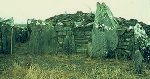
Sometimes the courts are beautifully constructed with the 'post-and-panel' technique.
What seems to me interesting is that human presence long preceded tomb-building. This reflects the complete difference of world-view between the hunter-gatherers and the stock- (and people-) enclosing tomb-builders. Modern hunter-gatherers, living in forests which they regard as entirely benign and holy, tend to lay out their dead in the forest, covered with brushwood and vegetation or basic/symbolic kinds of shelter, so that they make a sweet and appropriate transition from creature to humus. But those who clear forests in order to corral animals which, however valuable, they inevitably regard as inferior beings, do not regard the forest as entirely benign (though leaves collected from it are both summer and winter fodder). They tend to regard the spaces they have cleared as 'holy', and they do not like to envisage death as a cyclical process between human and humus. They - the farmers who have been assigned to the Neolithic or New Stone Age - invented the catastrophically-alienating concept of wealth, which we now see to be reducing the planet to resource and product increasingly overwhelmed by waste. The problem with concepts is that, once invented, they cannot be uninvented. Concepts are as much the contents of Pandora's legendary box as diseases. Thus the concept of "normality" (as distinct from orthodoxy) invented less than 200 years ago, has profoundly affected the lives of those who have a word for it. Once wealth is invented, the concept of inheritance immediately follows, along with other nasty ideas such as the retention of wealth, as opposed to the distribution of food ensured by (for example) hunter-gatherer potlatch cultures. From inheritance inevitably arise pedigree- and ancestor-worship of one kind or another. And so imposing tombs arer built, so that human beings can deceive themselves into continuing contact with the dead, either by ritual and trance, or by actual touching of the bones through an aperture - a practice which survived until recently in Europe, and probably still survives in that most conservative and culturally-layered peninsula of Europe, Italy.
Tomb-shrines of early Irish saints also feature apertures for such a purpose. But to return to Court-tombs, these mostly occur at a certain height (between 200 and 300 metres) because they were built on land cleared where the forest was thinnest - upland which was better-drained than, for example, the river valleys. There is a distinct possibility that they had wooden precursors.
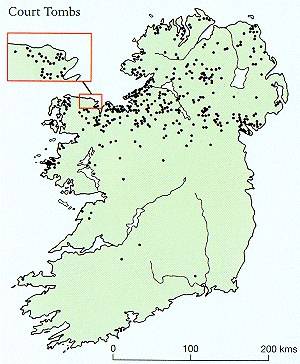
Some, near the coasts, occur where forest was thin due to sea-winds. Generally they concentrate to the north and east of Ireland. And, like other forms of Irish megalith, they are distinctively Irish although they have relatives not just in nearby south-west Scotland, but as far away as Languedoc in France, where some Allées-couvertes have an unroofed court-feature.
Like the allées-couvertes, they are long gallery-tombs encased in a covering mound of stones or stones and earth, called a cairn, corresponding to what in England is called a long-barrow. The gallery was where the burials were placed; in Ireland these were almost always burials of ashes after cremation.
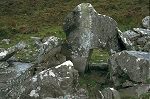
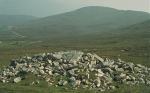
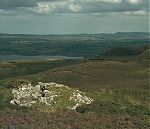
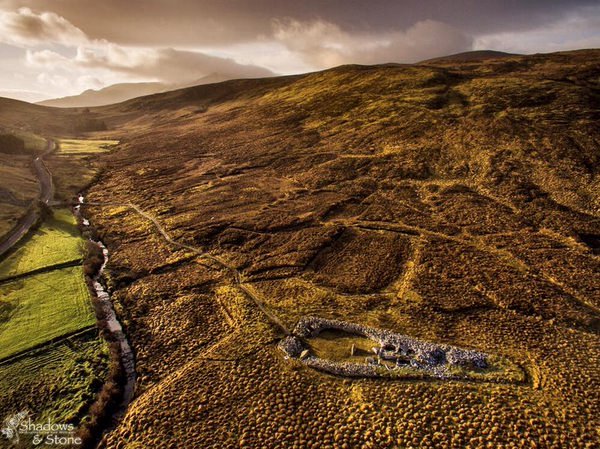
Many at first glance look like chaotic heaps of stones, but usually the gallery and/or the court can be discerned. Some, especially in county Mayo, are still largely embedded in the peat-bog which grew on top of them some centuries after they were built, and are very well-preserved.
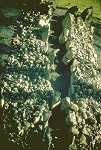
The galleries were roofed by large slabs often supported on corbel-stones placed on top of the orthostats or supporting wall-slabs to narrow the gap to be spanned.
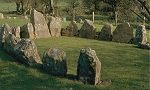
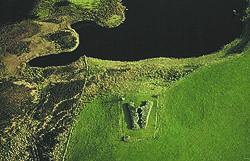
Their eponymous courts are most commonly a single, roughly- semicircular forecourt at the wider and higher front end of the cairn, which generally faces east. The orthostats of these courts presented an often-imposing façade.
Sometimes a second forecourt occurs at the rear, making the megalith a Double-court tomb.
More rarely, an unroofed, oval forecourt is found in the middle, with the burial galleries going off from each end, opposing each other along the axis of the tomb. These Central-court tombs are very large and hard to photograph.
Rarer still is the Full-court tomb, in which the forecourt is an oval enclosure approached through a narrow passage.
Occasionally, two separate tombs are close together.
It is often
thought that prehistoric tombs have fallen victim only recently
to the depredations of "progress". But many were pillaged
or deliberately wrecked shortly after their erection.
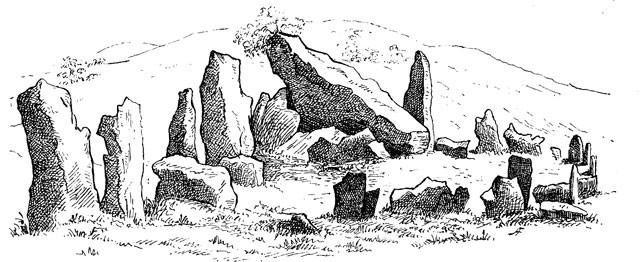
A 19th century sketch of a
ruined court-tomb in county Antrim known as
Cander's Walls -
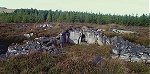
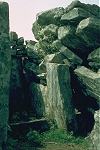
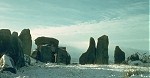
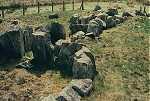
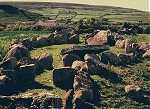
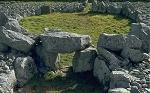
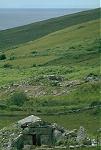
Cloghanmore, Malin More, county Donegal.
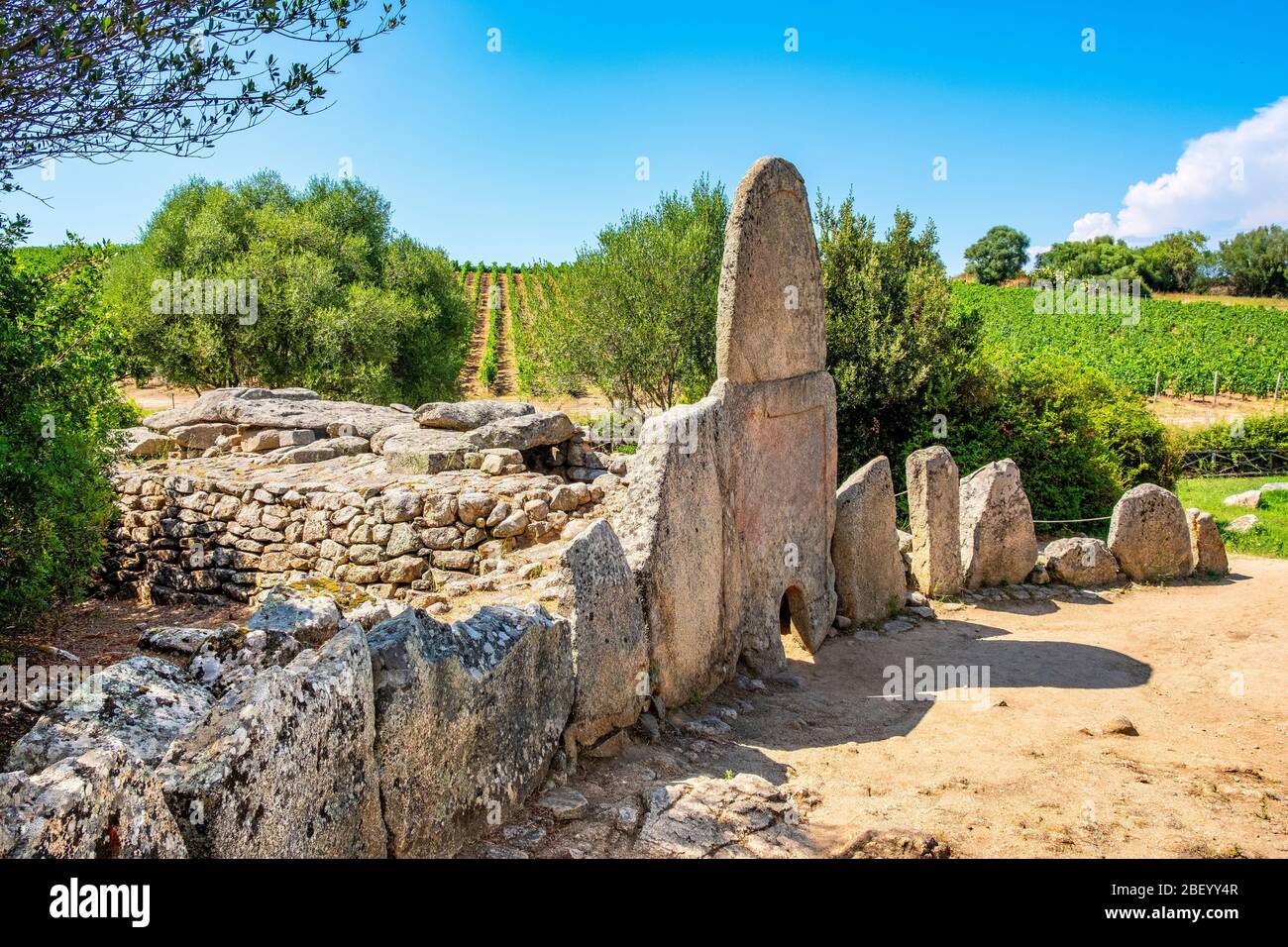
Compare with a similar type of tomb on the island of Sardinia
|

"The
past is not over - it has not even passed."
William
Faulkner
There is some likelihood that Irish court-tombs had
wooden precursors:
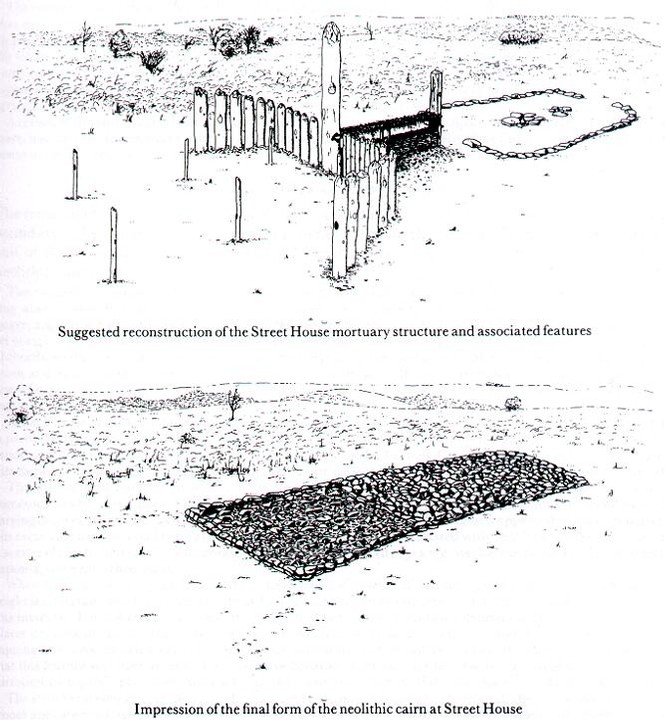
Illustration taken from a 1984 excavation report of a Yorkshire site by B.E. Vyner.
Click on the
thumbnails
to see large
high-
resolution
pictures.

Click on the
thumbnails
to see large
high-
resolution
pictures.
Click on the
thumbnails
to see large
high-
resolution
pictures.